The Right Information, for the Right Reason
Which representation should an AI system share when another system needs its help?
Imagine you're working with an AI coach. Over several months, you've shared your goals, routines, progress and setbacks. The coach has learned quite a bit about you, including details about your work, health and personal circumstances.
Now it needs to send an update to another system that prepares your weekly progress report. Which representation should it share?
A few milestones, completed activities and recent trends might suffice. Yet the coach could simply forward your conversation history, leaving the receiving system to decide what's relevant.
The report might turn out perfectly well. Both systems are authorized to process the information, and everything works as intended. Still, the receiving system has learned far more about you than it needed.
How often does this happen in the AI systems we're building?
The information we pass along
Modern AI applications are increasingly interconnected. Assistants retrieve documents, agents delegate tasks, tools return detailed records, and monitoring systems capture interactions for debugging and analysis.
We put considerable effort into controlling access and securing these exchanges. But authorization alone doesn't determine which representation a component needs for its particular purpose.
Consider our coach again. A progress-reporting service needs milestones and trends, while a quality-monitoring service might examine whether the coach overlooked an obstacle or made an inappropriate recommendation.
Both have legitimate purposes, although the information relevant to each is different. Sending the complete conversation to both is convenient, especially during development. It also discloses details they may never need.
Different purposes, different information
What if the coach prepared a different representation for each recipient?
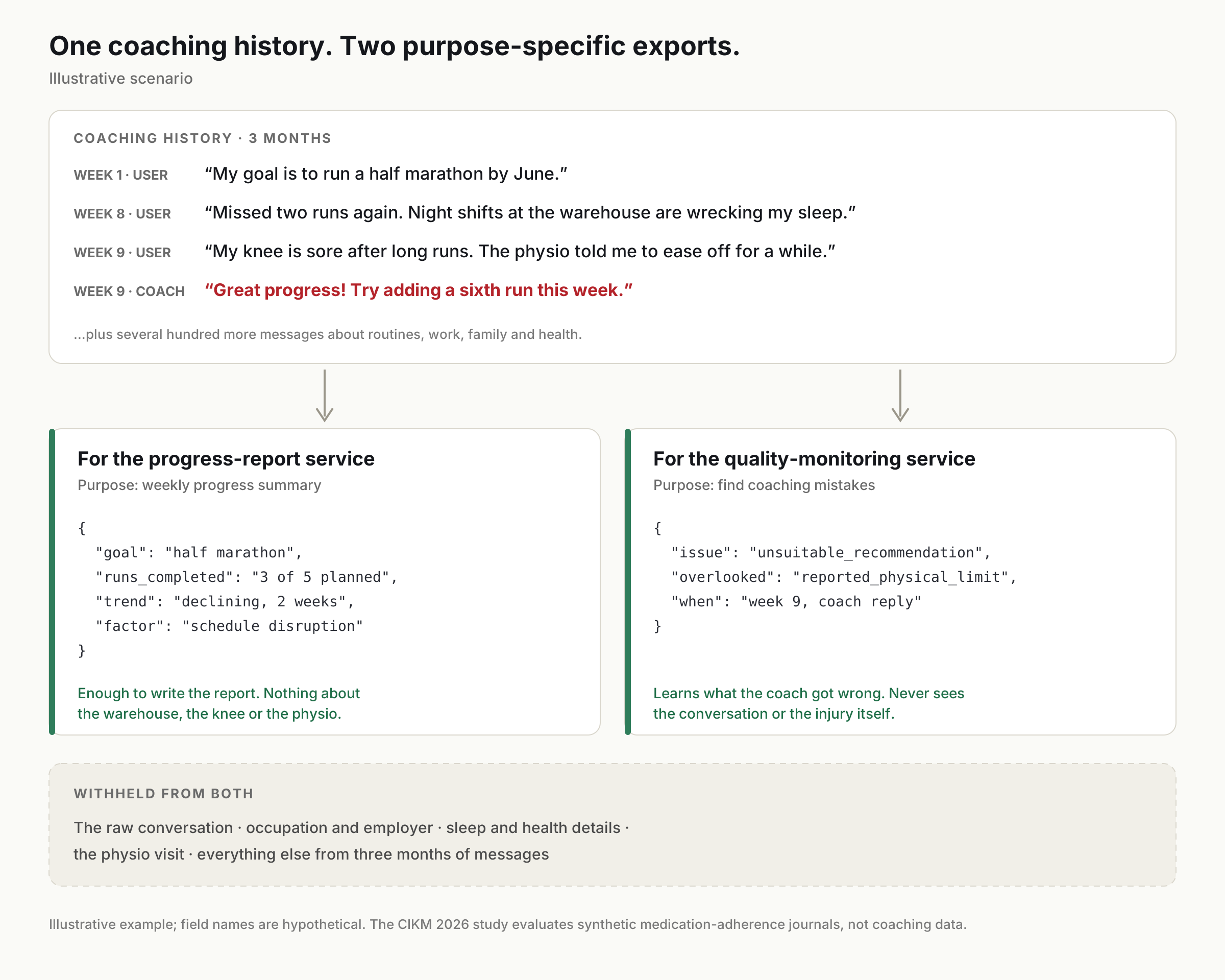
For the progress report, it could share completion rates, trends and factors affecting progress. For quality monitoring, it could share evidence of overlooked obstacles or unsuitable recommendations.
Neither necessarily requires the complete conversation.
Producing these representations reliably is harder than describing them. Removing names or replacing sensitive terms doesn't guarantee that the remaining information cannot be linked back to someone. And removing too much context can make an otherwise useful report misleading.
We need ways to determine what information to preserve, what to withhold and how to evaluate the result.
Exploring the idea through Semantic Boundary
These questions motivated Semantic Boundary, our research framework for policy-constrained semantic disclosure. Under that framework, sensitive inputs are transformed into policy-governed exports selected for a registered purpose and disclosure policy.
We developed the Semantic Boundary Benchmark (SBB) to investigate how different representations affect downstream task utility and residual linkage. The public artifact of that study is the Open Semantic Boundary Benchmark (Open-SBB).
Our first study, accepted at ACM CIKM 2026, compares nine lattice conditions across registered purposes using synthetic medication-adherence journals. The experiments examine how well each representation supports its intended task and what residual linkage remains under the study's registered assessors.
An interesting finding is that no single transformation performs best across every purpose. The preferred representation changes with the purpose and disclosure constraints.
This is an initial study in a synthetic setting. Applying the approach to real-world AI systems will require further evaluation, particularly when purposes, policies and information needs change over time.
A question worth exploring
As AI systems become more interconnected, we're interested in making information-sharing decisions more deliberate.
Which representation should cross for each receiving purpose?
We're curious how other teams approach this. When your agents or services exchange information, do you explicitly decide which representation each recipient needs, or does that emerge as the system evolves?
We'd love to hear what you've tried, what has worked and where you've run into difficulties.
If you find this interesting, talk to us.
Read further
- Series Part 2: Semantic Boundary, What We Built, Tested, and Learned Part 3: Your AI Agent Has Access. What Does It Need to Know?
- Paper · ACM CIKM 2026 Semantic Boundary: A Framework and Benchmark for Policy-Constrained Semantic Disclosure doi.org/10.1145/3799682.3840076 ↗
-
Open-SBB The open benchmark from the study.Explore Open-SBB ↗
-
Short survey About three minutes. Where sharing gets difficult in your systems.Take the survey ↗
-
Does your system have this problem? gb@nimblenotions.caTalk to us
- ← Back to Semantic Boundary
The coaching scenario is illustrative. The CIKM study evaluates synthetic medication-adherence journals.